

AI Trust Dispatch
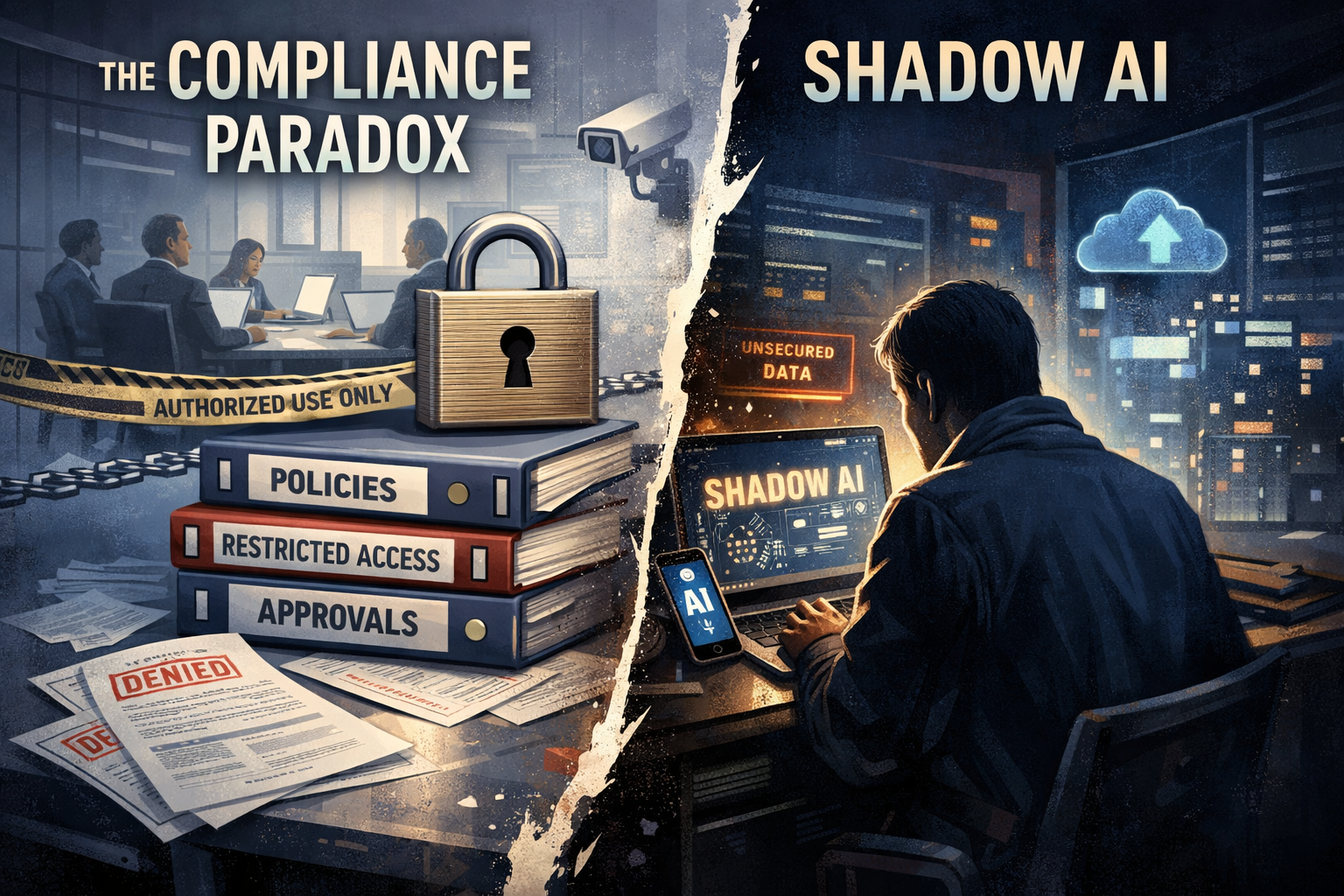
The Compliance Paradox: Why Rigid Rules Drive AI into the Shadows
7 May 2026
For a COO, Chief Risk Officer, or CMIO, the natural response to a high-variance technology like Generative AI is to build a fortress. We see the risks—hallucinations in clinical summaries, data leakage in proprietary financial modeling, or biased adjudication in insurance—and we respond with Instructional Rigidity. We create 40-page policy manuals, multi-level approval committees, and restrictive "allow-lists" that prioritize safety through exclusion.
But in behavioral science, we see a recurring phenomenon known as The Compliance Paradox. When the "cost" of following the rules (in time, effort, or cognitive friction) exceeds the perceived utility of the tool, professionals do not stop using the technology. They simply stop telling you about it.
The Rise of "Shadow AI" and the Transparency Vacuum
In a hospital or a financial firm, the pressure to maintain productivity is absolute. If a clinician finds that an unauthorized LLM can summarize a 50-page longitudinal patient history in seconds, but the "approved" institutional tool is locked behind a six-month pilot, they will use their personal device.
This creates a Transparency Vacuum that introduces three systemic risks to your bottom line:
1. Unmonitored Data Leakage
You cannot audit what you cannot see. "Shadow AI" means proprietary financial logic or Protected Health Information (PHI) is being processed on consumer-grade servers without institutional oversight. This isn't just a policy violation; it's a massive regulatory liability waiting for a discovery request.
2. The Erosion of Institutional Alpha
When usage is unofficial, the organization loses the ability to aggregate feedback. You can't refine your models or build a collective knowledge base if your best "power users" are hiding their workflows to avoid a reprimand. You are effectively outsourcing your innovation to third-party consumer apps while your internal systems remain stagnant.
3. The Enforcement Gap
Once a critical mass of your workforce is using unauthorized shortcuts to hit their KPIs, strict enforcement becomes an operational impossibility. You cannot fire your entire claims department for using a tool that makes them 30% more efficient. At that point, the policy is no longer a safeguard—it’s a fiction that undermines the authority of the C-suite.
The Behavioral Mechanics of "Shadow Workflows"
Why do smart, ethical professionals bypass the rules? It is rarely out of malice; it is almost always out of Functional Necessity. In high-stakes industries, experts are measured by outcomes. If the official AI governance process is viewed as a "Black Box" of rejection or a slow-moving bureaucracy, the expert perceives it as an obstacle to their primary mission (patient care, risk management, or financial growth).
The Trust Mismatch: Leadership views rigid compliance as "Risk Mitigation." The front-line expert views it as "Incompetent Oversight." This mismatch is where Procedural Justice breaks down.
The Strategic Solution: Moving Toward "Low-Friction" Governance
To solve the paradox, leadership must shift from Restriction to Behavioral Alignment. Effective governance in 2026 isn't a wall; it’s a paved path. If the compliant path is the easiest path, your experts will follow it.
A. The 48-Hour Sandbox: Speed as a Safety Feature
Innovation moves faster than committee cycles. Instead of a six-month review, create a safe, air-gapped "Playground" where teams can test non-PHI use cases immediately. Speed is not the enemy of safety; it is the prerequisite for transparency. If you don't give your experts a sandbox, they will treat your production environment as one.
B. Tiered Risk Profiles (Nudge over Ban)
Not all AI tasks carry the same weight. Summarizing a meeting transcript should not require the same governance hurdle as a diagnostic suggestion or a credit risk score.
Low Risk: Instant automated approval with standard logging.
Medium Risk: Peer-review or department-level sign-off.
High Risk: Full Human-in-the-Loop audit with variable salience tracking.
C. Incentivized Disclosure: Turning Risk into Insight
Reward teams for reporting how they are using AI—even unauthorized tools. By treating "Shadow AI" as an Unmet User Need rather than a policy violation, you can bring those workflows under institutional security and turn hidden risks into vetted pilot programs. This is the difference between being a "Gatekeeper" and being a "Pioneer."
The Executive Takeaway: Audit for Resilience, Not Just Accuracy
Rigidity is not the same as safety. In a rapidly evolving landscape, your most effective governance tool isn't a policy manual—it's Procedural Justice. If the process is fair, fast, and transparent, users will stay within the lines. If it's a bottleneck, they will find a way around it.
The question for the board isn't "Have we banned the risk?" but "Have we made the safe path the simplest path?"