
The Adoption Gap
Why AI adoption stalls — and the one category that most strongly predicts whether employees actually keep using it.
Based on an original survey of 523 professionals across healthcare, finance & insurance, and manufacturing & operations, this report tests five commonly assumed drivers of AI adoption, change management, technical quality, incentives and culture, regulatory confidence, and psychological trust, against each other. One factor consistently predicts actual usage and continued adoption more strongly than the rest combined.
-
Published
October 2026 -
DOI
Coming soon -
-
523
professionals surveyed across three sectors, all current users of AI tools.
-
2×
psychological trust's predictive weight versus the next-strongest category.
-
10×+
psychological trust's weight versus change management specifically.
Author:
Eugene Y. Chan
Most organizations assume AI adoption stalls because of weak communication, insufficient training, or tools that aren't accurate enough. An original survey of 523 professionals across healthcare, finance and insurance, and manufacturing and operations tested that assumption directly, measuring five commonly assumed drivers of adoption and checking which ones actually predict behavior once they're all considered together, rather than relying on which one people happen to rate highest.
The answer is clear, and it isn't the one most organizations are acting on. When change management, technical quality, incentives and culture, regulatory confidence, and psychological trust are tested against each other simultaneously, psychological trust wins decisively. It predicts actual usage and continued adoption roughly twice as strongly as the next-closest category, and more than ten times as strongly as change management, the lever most organizations reach for first.
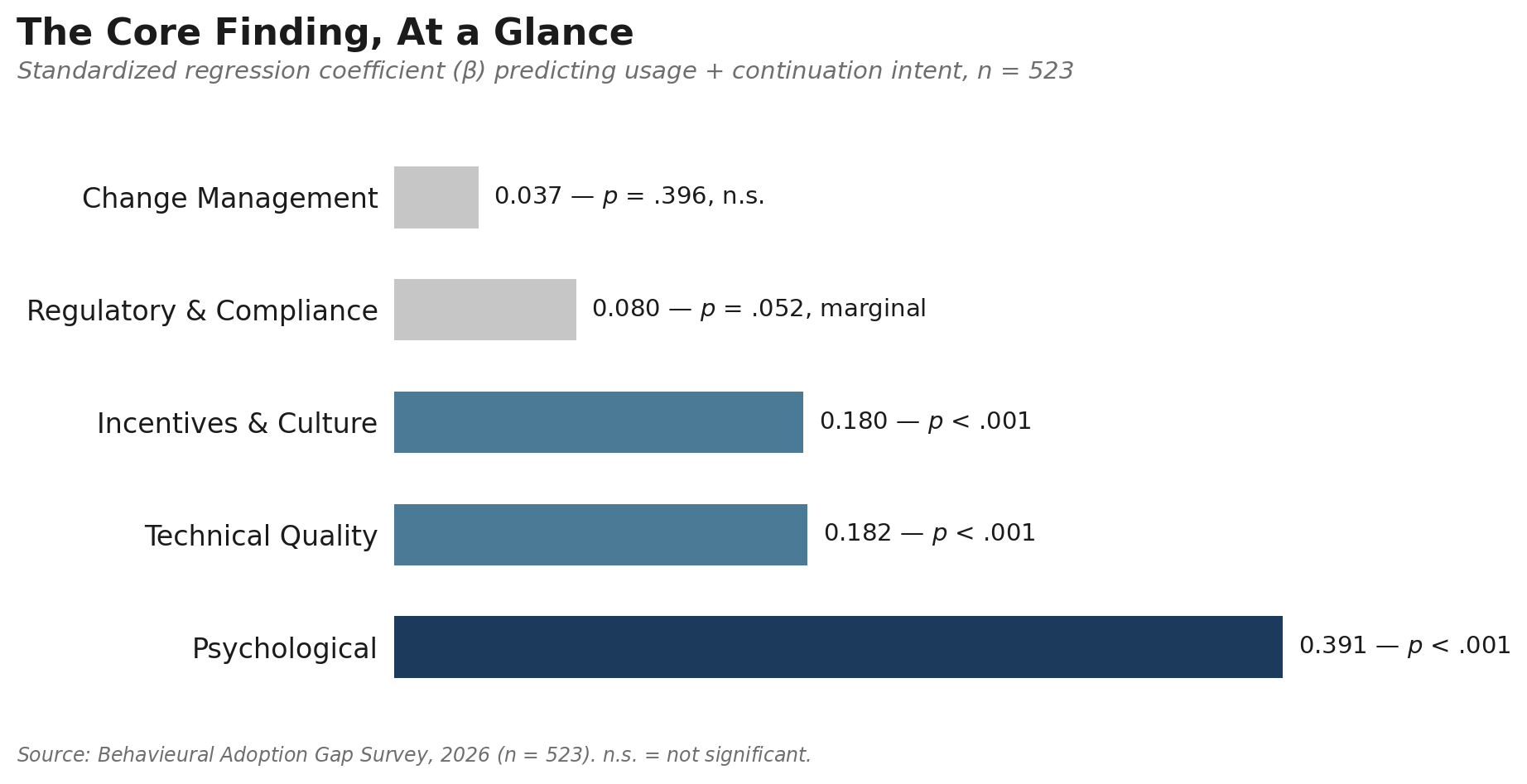
That gap isn't a rounding error, and it isn't close. An organization that responds to slow AI adoption with a clearer rollout announcement and a refreshed training module is optimizing for the two things that matter least, while leaving the one that matters most untouched.
Worth being precise about what this finding is and isn't. It doesn't mean technical accuracy or incentive structures are irrelevant, both remain real, significant contributors in this data. And the psychological effect itself isn't one silver-bullet variable; it reflects several dimensions of trust working together, whether people trust the AI's reasoning, feel in control rather than overridden, and believe mistakes can be caught and corrected, reinforcing each other rather than any single concern carrying the whole effect alone.
What that means in practice: trust isn't a soft add-on to a rollout plan, it's closer to a precondition. A technically excellent, well-incentivized tool that people don't trust enough to rely on may never get the chance to prove its accuracy or its reward value in the first place.
Key takeaways.
-
Psychological trust is the strongest predictor of AI usage, by a wide margin.
Once all five categories are tested against each other simultaneously, trust in the AI's reasoning, a preserved sense of control, and confidence that errors are recoverable outweigh technical accuracy, incentive structures, and communication quality, carrying more than double the predictive weight of the next-closest category.
-
This is a composite effect, not a single lever.
The finding reflects several converging dimensions of trust working together, not any one psychological concern operating in isolation, a distinction that points organizations toward building trust through multiple channels rather than one program.
-
The pattern holds in every sector studied, with real variation in what comes second.
Healthcare pairs psychological trust with technical accuracy. Manufacturing & Operations pairs it with incentives and culture. Finance & Insurance shows the most multi-causal pattern of the three, with incentives, technical quality, and regulatory confidence all contributing alongside trust.
-
Communication and training show no independent effect anywhere.
Change management, the lever most organizations reach for first when adoption stalls, carries no statistically significant weight once the other four categories are accounted for, in the aggregate sample or in any single sector.
-
Read the Full Report
The report is free. It includes the complete five-category breakdown for each sector, the full behavioral-theory explanation for why psychology matters most, the disaggregated AI Trust Axis findings, and five evidence-backed moves that close the gap.
Research approach.
Behavieural fielded an original survey, screening for professionals whose organization currently uses AI or automated decision-support tools, across healthcare, finance & insurance, and manufacturing & operations. Nineteen core statements across five categories were measured on a five-point agreement scale, alongside two behavioral outcomes, usage frequency and intent to continue, combined into a single composite measure.
Regression analysis, which isolates each category's independent contribution once the other four are accounted for, was used throughout rather than simple agreement rates, since respondents tend to rate every category somewhat positively together, a pattern that can mask which factor is actually connected to behavior. The report's methodology section addresses this and several other likely criticisms directly, including the perception-based measurement approach and the iterative nature of the data collection.