
The Confidence Gap
Executives tend to believe AI oversight is working. The people who use AI tools every day largely do not agree. This report measures how large that disagreement is, where it concentrates, and what it means for any leader who assumes a policy is functioning the way it was designed to.
-
Published
7 September 2026 -
DOI
10.5281/zenodo.23306220 -
-
770
professionals surveyed on AI oversight at their organizations.
-
6 of 10
governance measures show a significant gap between leaders and staff.
-
23 pts.
widest gap, on whether AI training changed day-to-day behavior.
-
28%
of those asked say their AI vendor's safety claims were independently tested or audited.
-
The Gap Clusters Around Proof
In a survey of 770 professionals across healthcare, finance and insurance, and manufacturing and operations, managers and executives were significantly more confident than individual contributors on six of ten dimensions of AI governance, sometimes by more than twenty points on the identical statement. Every gap reported as significant held under statistical testing.
The six largest gaps are not scattered. They cluster around verifiability: whether something can be proven, explained, or shown to have actually changed, rather than whether it exists on paper. Training and explainability show the widest gaps of all, and both ask whether something changed a person’s real capability. Verification and vendor-claims checking show smaller gaps, though still large, because they are closer to checkable facts. The narrowest of the six, vendor-claims verification, is still sixteen points.
That consistency matters more than any single number. One gap could come from how a question was worded. Six gaps of this size, all pointing the same way across statements as different as training and incident documentation, describe a structural pattern.
The likely mechanism is a blind spot built into reporting lines. The systems leadership uses to judge oversight are often built and maintained by the people being overseen. A training-completion dashboard shows that training was completed, not that it changed anything. A signed-off review log shows that a signature exists, not that judgment was applied before it was signed. Leaders see the artifact and reasonably infer the practice. Individual contributors see the practice directly.
-
What the Study Measured
Respondents rated agreement with ten statements about AI oversight at their organization, covering verification, ownership, incident handling, explainability, vendor claims, override, training, fairness, forced tool use and the point at which extra review steps push people to route around them. Follow-up questions asked what respondents had actually observed, and open-ended items collected their own accounts of AI failures.
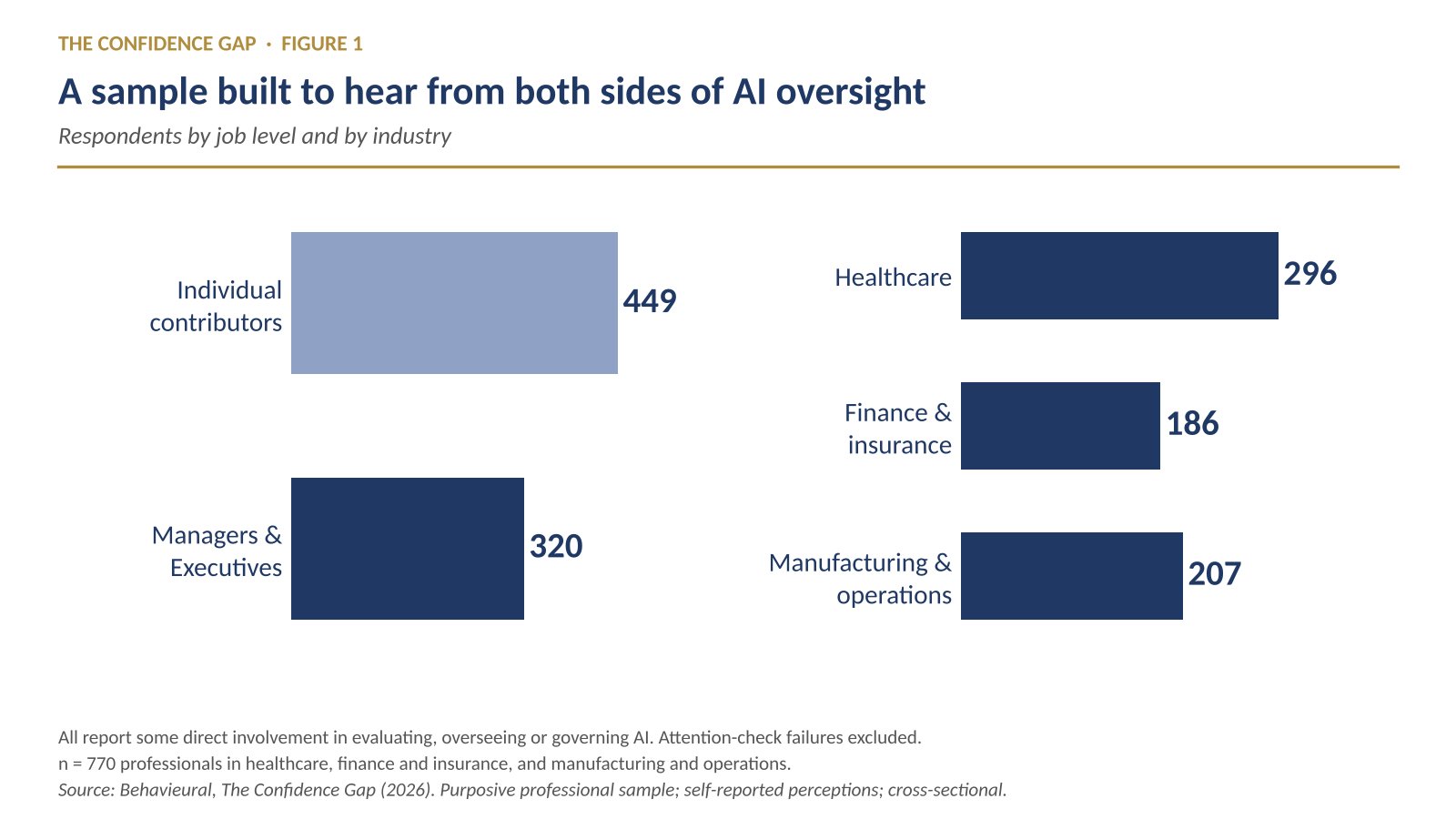
Sample. 770 working professionals with some direct involvement in evaluating, overseeing or governing AI or automated decision-support tools, in the United States, Canada and the United Kingdom.
Industries. Healthcare (n = 296), finance and insurance (n = 186), manufacturing and operations (n = 207).
Job level. Individual contributors (n = 449) and Managers & Executives (n = 320).
Design. Ten core statements on a five-point agreement scale, plus categorical and open-ended follow-ups and an attention check. Purposive professional sample, self-reported perception, cross-sectional.
What the Report Finds
-
It is seniority, not familiarity with the jargon.
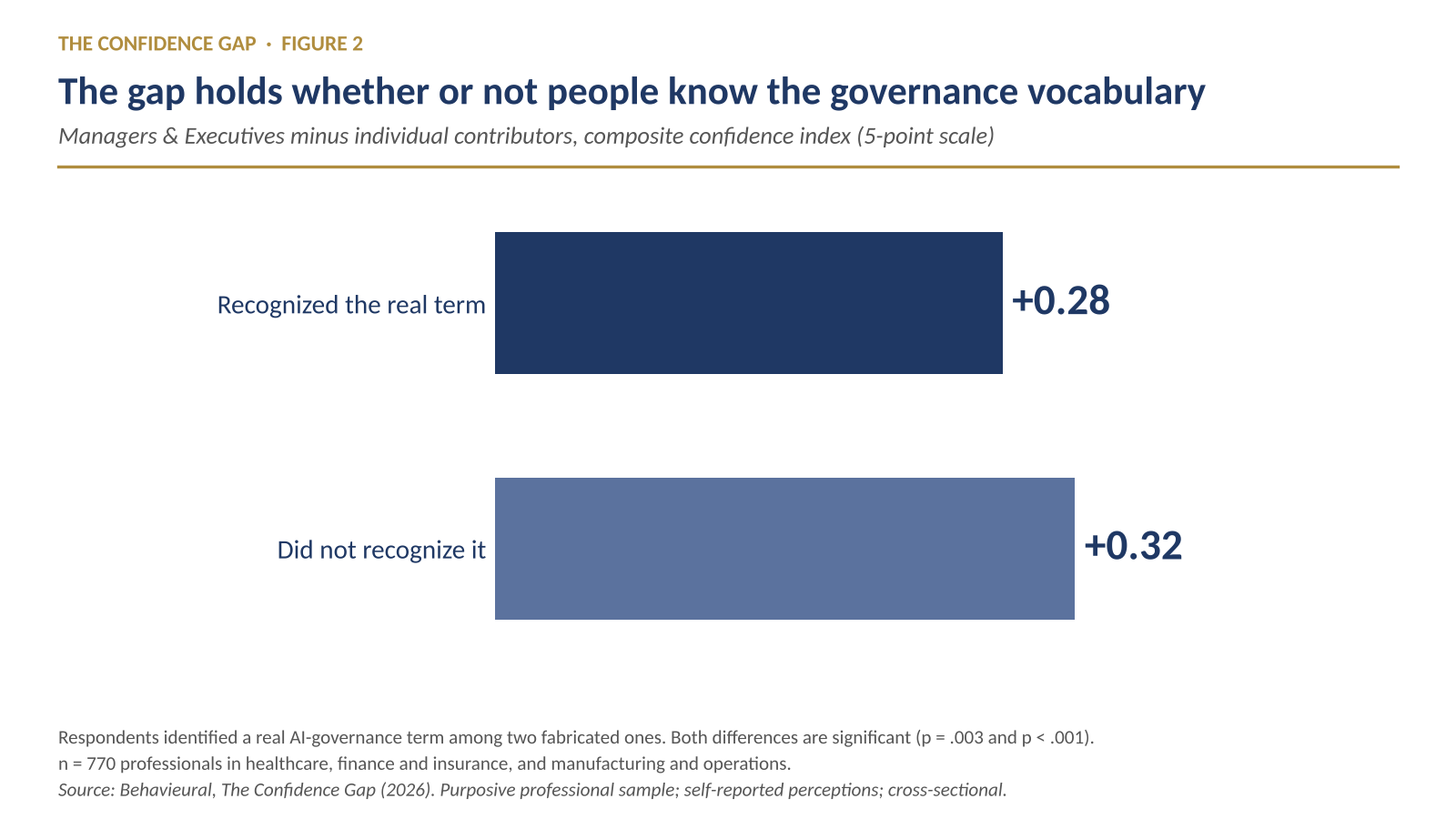
One objection is that managers simply know AI governance vocabulary better. The survey tested this by asking respondents to identify a real governance term among two fabricated ones. Among those who recognized the real term, managers and executives still scored 0.28 points higher than individual contributors on the composite confidence index. Among those who did not, the gap was slightly larger, at 0.32. If familiarity were the driver, the gap should have shrunk among the literate group. It did not move.
-
Experience builds confidence, but only partly.
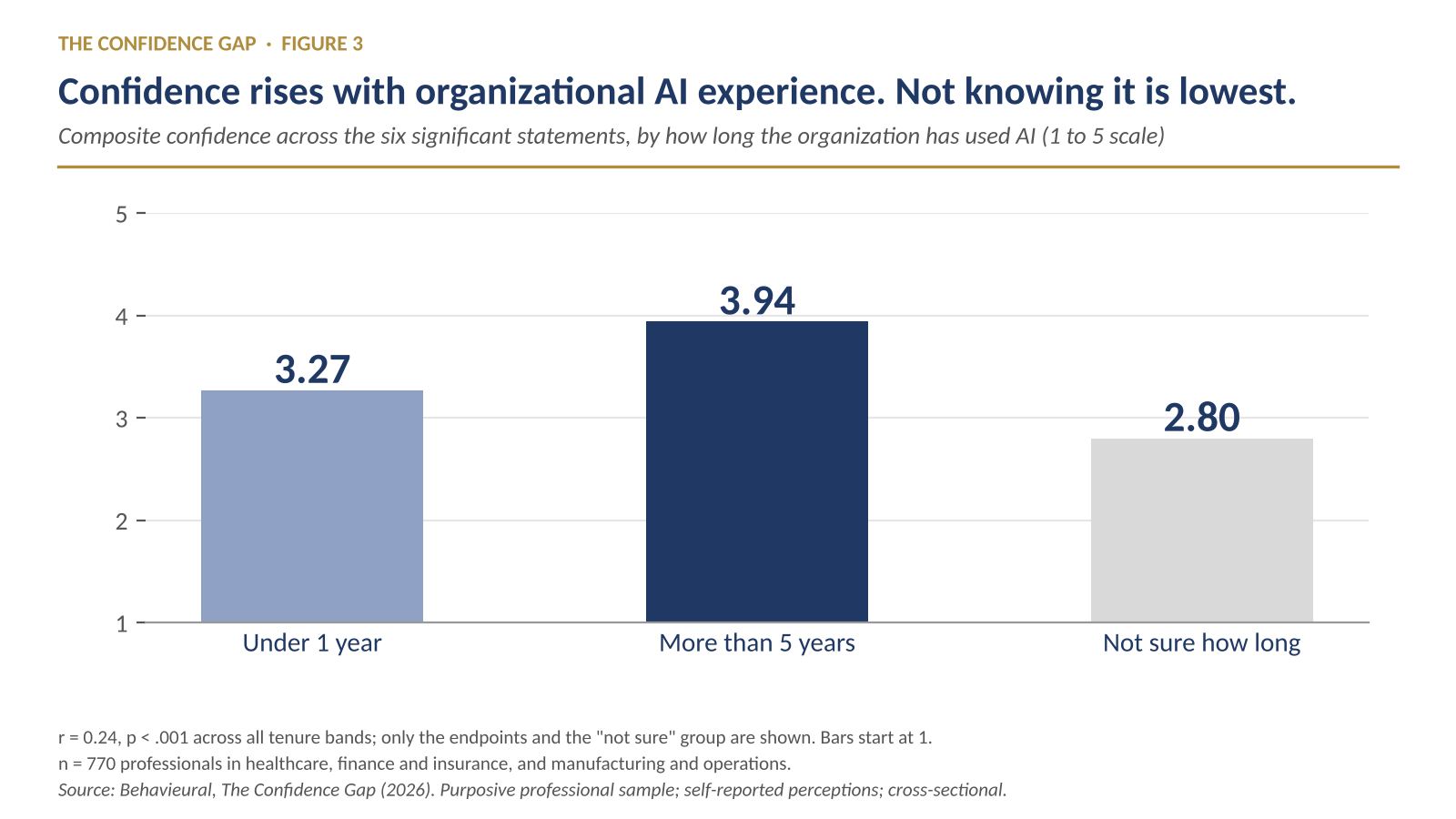
Composite confidence rises steadily with how long an organization has used AI, from 3.27 under one year to 3.94 beyond five. The lowest score of any group, 2.80, belongs to respondents who do not know how long their organization has used AI, which looks less like a tenure effect than a sign of distance from how AI is governed there. The trend is a correlation. It fits both a survivorship story, where organizations that stay with AI were already getting oversight right, and a learning story, where oversight matures. Either way, early-stage deployments are where confidence is least earned and most worth independently checking.
-
IT owns oversight by default.
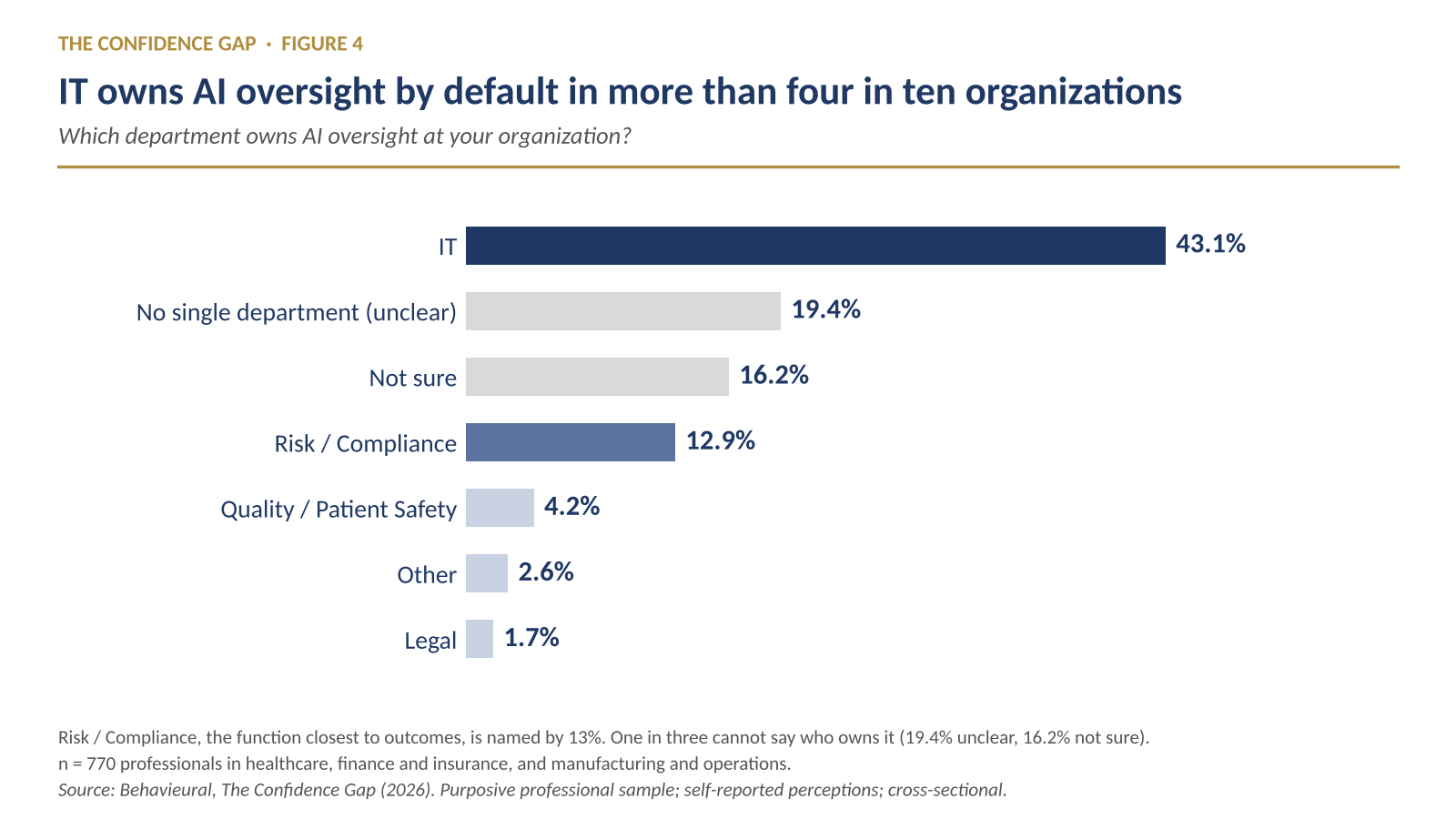
Asked which department owns AI oversight, 43.1% name IT. Another 19.4% say no single department does, and 16.2% are not sure. Risk and Compliance, the functions closest to what AI outputs actually do, are named by 12.9%. AI tools get provisioned and maintained by IT long before anyone decides who is accountable for what the tool recommends, which leaves a separation-of-duties gap: the function best placed to judge clinical, financial or operational risk is usually not the one holding the pen.
-
Incidents are documented more often than they change anything.
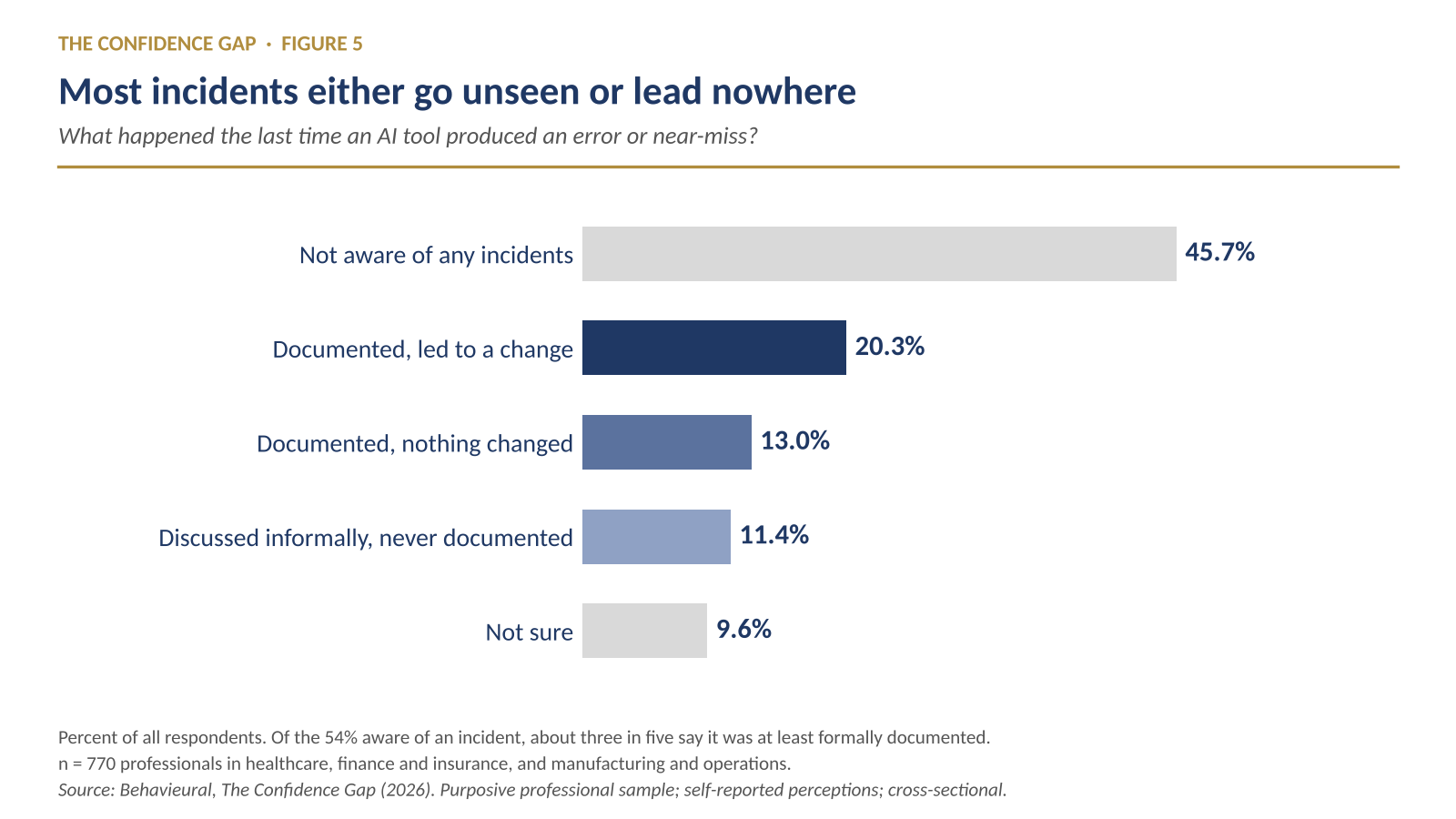
Nearly half of respondents (45.7%) are not aware of any AI incident. Among the 54% who are, roughly three in five say it was at least formally documented. But only 20.3% of all respondents say documentation led to a policy or process change, while 13.0% say it was documented and nothing changed. Documentation that never feeds back into a decision is filing, not governance. It satisfies an audit checklist without closing the loop that would prevent the same failure twice.
-
Most vendor claims were never independently tested.
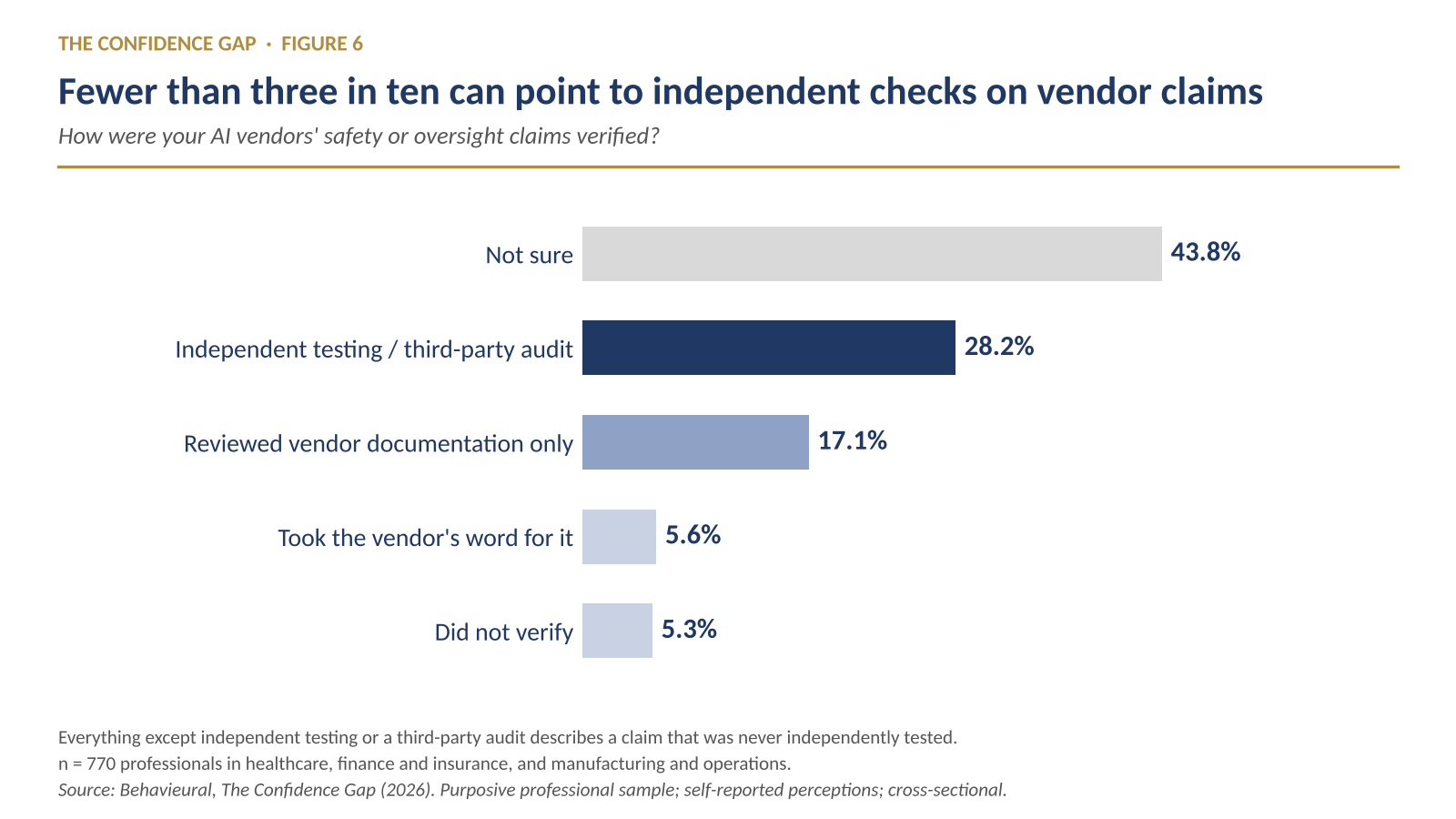
Only 28.2% of respondents point to independent testing or a third-party audit behind their vendors’ safety claims. Another 17.1% reviewed vendor documentation only, 5.6% took the vendor’s word for it and 5.3% did not verify. The largest group, 43.8%, is not sure. Everything other than independent testing describes a claim that an auditor or regulator will not accept as evidence.
-
The gap is real in every sector, and widest where stakes are highest.
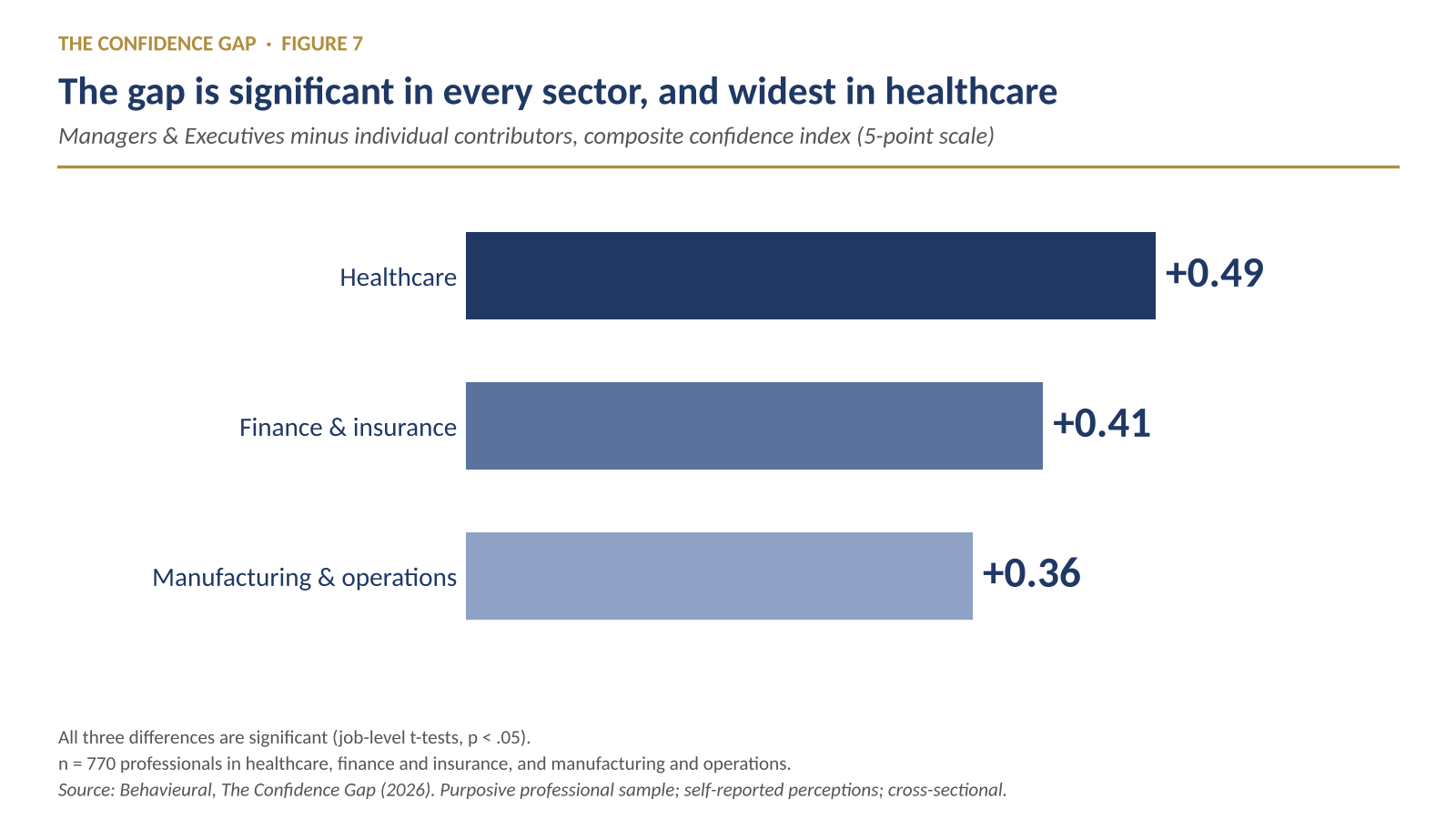
The confidence gap is significant in all three sectors, so it is a general feature of how AI oversight is experienced by seniority, not a healthcare or finance quirk. It differs in size. Healthcare shows the widest gap on the composite scale (0.49), finance and insurance sits between (0.41) and manufacturing and operations is narrowest (0.36). Higher clinical stakes may widen the distance between what leadership assumes is being checked and what individual contributors know is.
-
Sector and seniority together find the extremes.
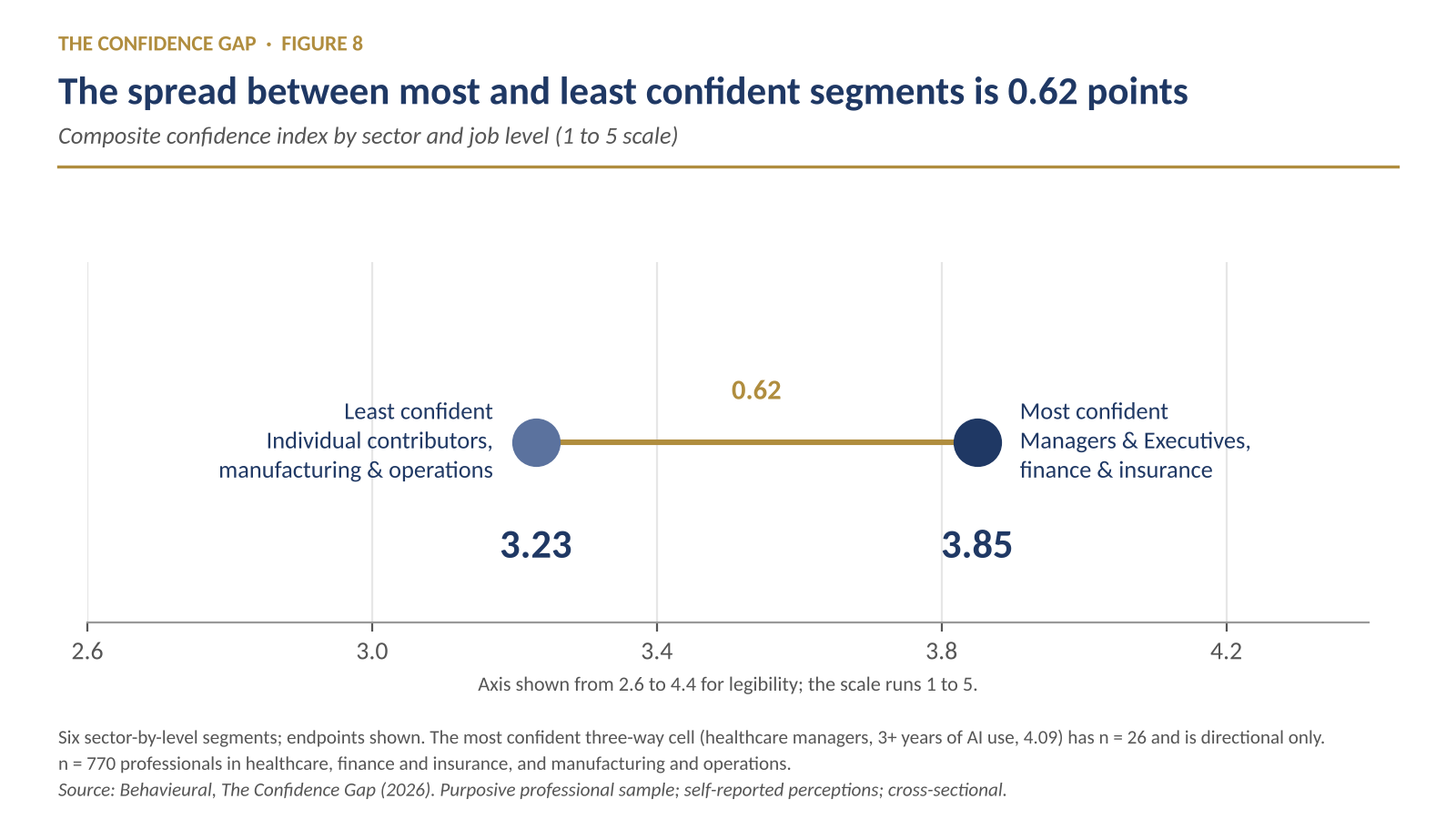
Combining sector and seniority gives six segments. The most confident is managers and executives in finance and insurance (3.85 on the composite index). The least confident is individual contributors in manufacturing and operations (3.23). That 0.62-point spread is larger than the gap between any two sectors on their own, and larger than the seniority gap within any single sector. A finer cut by AI tenure puts healthcare managers and executives at organizations with three or more years of AI use highest of all at 4.09, but that cell holds only 26 people and is directional.
What Closes the Gap
-
Make verification a standing artifact, not a point-in-time claim.
“We could produce documentation” should be true continuously, not only the day the policy was written. Spot-check a small sample of AI-assisted decisions each quarter and confirm the documentation exists, the way a finance team samples transactions.
-
Assign explicit ownership before the next incident.
Ownership assigned by infrastructure convenience, not by who answers for the outcome, turns a minor AI error into an unassigned one.
-
Treat vendor claims as unverified until tested.
Only about a quarter of respondents point to independent testing. Reviewed documentation, the vendor’s word and no check at all are claims an auditor or regulator will not accept as evidence.
-
Measure whether training changed behavior, not whether it was completed.
Training shows the widest gap in the survey. A completion certificate is not evidence the training worked. A measurable change in how people use the tool afterward is.
-
What the Study Can and Cannot Say
This is a purposive professional sample, not a population-representative one, and it measures self-reported perception, not audited organizational practice. A respondent’s confidence that documentation could be produced is not the same as documentation being produced. That is, in part, the point: perception and evidence are the two things that come apart in the findings. Job-level comparisons used independent-samples t-tests, and only differences marked significant met p < .05. Findings not marked significant are descriptive and directional.
The tenure trend is a correlation and cannot separate survivorship from learning.
Where to Go From Here
-
Could we produce evidence that a specific AI-assisted decision received meaningful human review?
A single-decision audit, completed in three to five business days.
-
Does our governance architecture produce the oversight behavior it is designed to?
A governance-system diagnostic that tests whether oversight works in practice, not only on paper.
-
Is AI genuinely adopted the way leadership believes it is across the organization?
A deployment-wide adoption diagnostic, delivered in 21 days, that compares what leaders see with what the people using AI experience.
-
Will pilot-level trust in AI survive as it scales enterprise-wide?
A scale-up trust diagnostic for organizations moving from pilot to enterprise-wide use.