

Compliant is not the same as approved.
CLEAR helps healthcare AI vendors turn compliance evidence into a package that a hospital AI governance committee can understand, evaluate, defend approving.... and tests whether it works.
CLEAR Diligence-Ready Evidence for Healthcare AI
-
72%
of surveyed health systems report AI governance committees. (BVP)
-
36%
of surveyed providers report delaying or canceling AI purchases over regulatory uncertainty. (BVP)
-
14%
of surveyed organizations report verifying their vendors’ AI safeguards. (Clearwater)
The review is where good vendors stall.
Many healthcare AI vendors do the hard work. They complete the security audit, sign the agreements, and document their controls. Then a hospital AI governance committee reviews the product, and the deal slows down anyway.
A committee does not only ask whether controls exist. Each member has to decide whether the evidence supports the claim, whether they understand it well enough to explain it, and whether they can defend saying yes if something goes wrong later. A package can be sound and still fail those tests.
-
What It Is
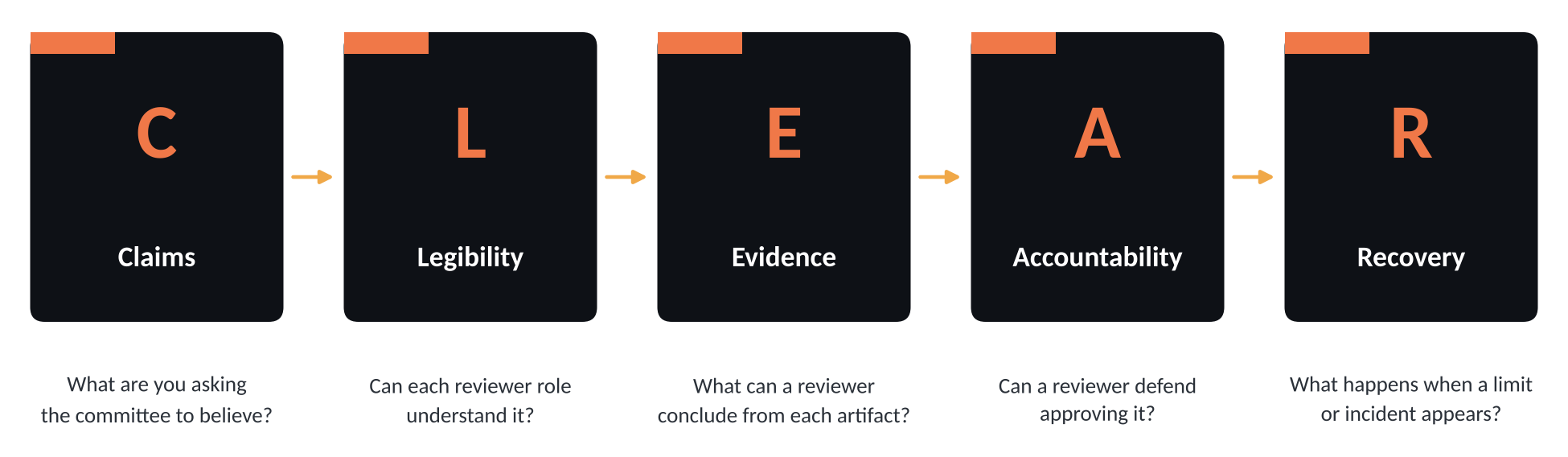
CLEAR is both our offering and our framework. It follows a vendor’s evidence from the vendor’s package to the committee’s decision and asks where it can lose force along the way. There are five stages.
-
C: Claims
What are you asking the committee to believe?
Vague or sweeping claims invite scrutiny. Specific, bounded claims are easier to evaluate and harder to dismiss. We calibrate each claim to the evidence behind it, so you ask for belief you can support.
-
L: Legibility
Can each reviewer role understand it?
A security lead, a privacy officer, a clinician, and a procurement manager read the same package differently. We map who sits on the committee and rewrite each part so the person responsible for it can follow it without translation.
-
E: Evidence
What can a reviewer conclude from each artifact?
A report or certificate matters only for what a reviewer can infer from it. We look at each artifact from the reviewer’s side and flag where it proves less than the claim it is attached to, or where the reviewer is likely to read more into it than it supports.
-
A: Accountability
Can a reviewer defend approving it?
Reviewers who expect to answer for a decision look for reasons they can repeat later. We help your package give them those reasons in plain language, so approval is something a reviewer can explain to their own leadership.
-
R: Recovery
What happens when a limit or incident appears?
Every AI product has limits, and every vendor eventually has an incident or a hard question. Committees notice who has thought about it in advance. We draft and test the language you would use, so the first time it is said is not in a crisis.
-
The Calibration Gap
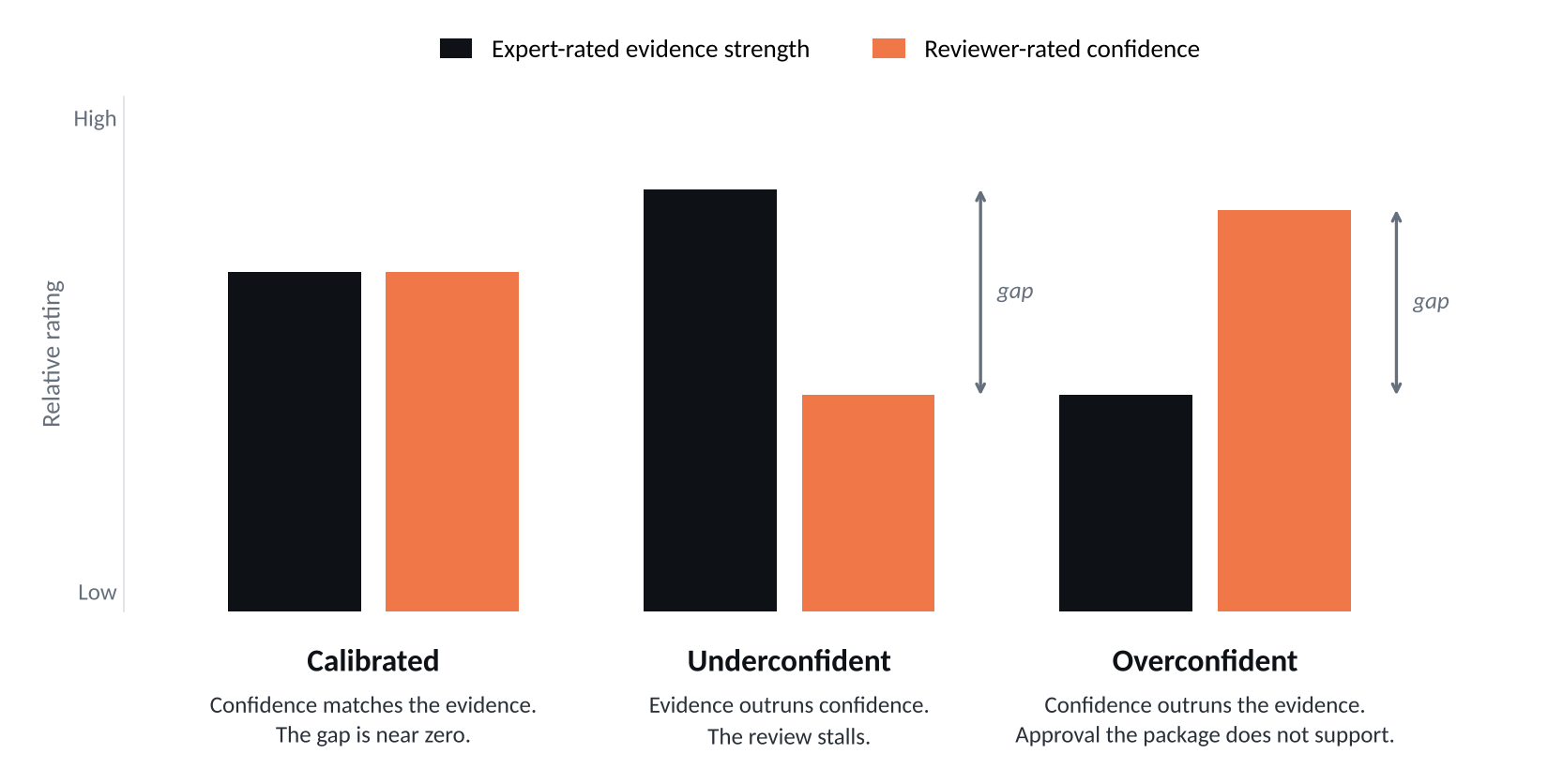
We use the term Calibration Gap for the distance between how strong an expert judges the evidence to be and how confident a reviewer feels about it. The two should match. Often they do not.
When reviewers are less confident than the evidence warrants, the review stalls and the vendor loses time. When they are more confident than the evidence warrants, approval arrives that the evidence does not support, and that risk belongs to everyone involved, including the vendor.
CLEAR aims for calibrated confidence, not maximum confidence. The goal is a package whose persuasive force matches its actual strength.
Importantly, most reviews are judged by whether documents exist. CLEAR also measures how reviewers respond to them. The Calibration Gap gives a vendor something a checklist cannot: a read on whether the people deciding are likely to be too cautious or too trusting, and why.
What You Receive
-
Committee Map
A map of who is likely to review your package, what each role needs to see, and which questions each is likely to ask. You get it before the review, so your package answers the people who will actually read it.
-
Claim Calibration
Each claim in your materials is matched against the evidence behind it. Claims that outrun their evidence are narrowed or supported. Claims that undersell are strengthened. The result is a set of statements your team can stand behind in a committee room.
-
AI-Specific Disclosure Draft
A draft that covers limitations, bias evaluation, data use, and change notification, the topics reviewers increasingly ask about for AI products. We write it for readability and structure. Your counsel or compliance partner reviews it before it is used.
-
Incident Communication Language
Tested wording for the moments buyers worry about most: a model error, a data issue, a change in performance. Drawing on our crisis communications research, we prepare the language in advance so your response is steady, specific, and consistent.
-
Buyer Friction Map
A triage of what is slowing your review, sorted by what kind of problem it is and who should fix it. This is where we are honest about what CLEAR can and cannot do.
-
Reviewer Panel Test
A small panel of representative reviewers reads your package. We measure what they understand, what risk they perceive, and the Calibration Gap, so you see where confidence and evidence diverge before the real committee does.
-
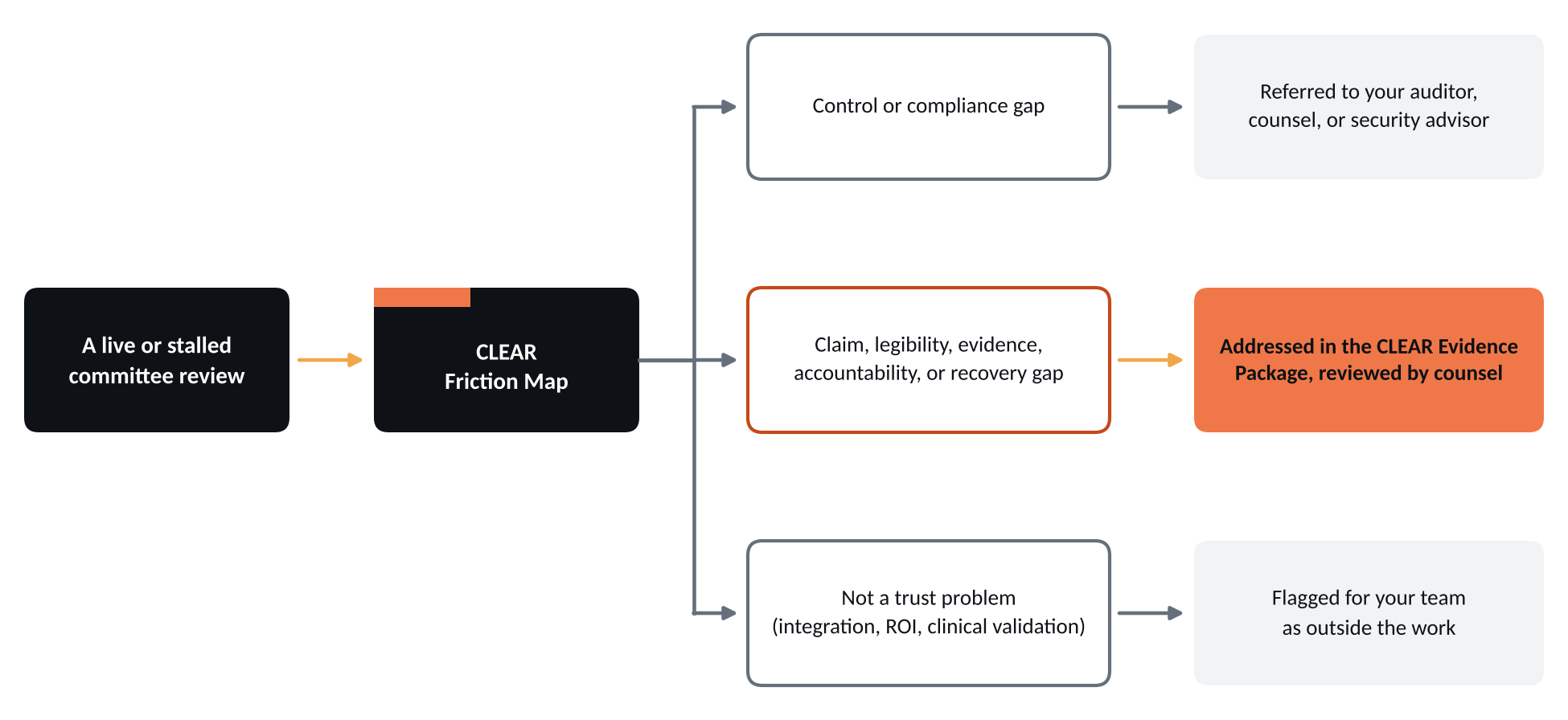
Not every barrier is a communication problem. If the barrier is a control or compliance gap, we refer you to your auditor, counsel, or security advisor. If it is a gap in claims, legibility, evidence, accountability, or recovery, we address it in the package, with counsel reviewing the language. If it is something else, such as integration, return on investment, or clinical validation, we tell you plainly that it falls outside this work so you can direct your effort where it will matter.
-
How the Work is Grounded
Built on public buyer-side standards.
We anchor the work in the materials buyers themselves publish and use. These include Joint Commission and CHAI guidance on responsible AI use in healthcare, CHAI model cards, the HSCC guide, and published vendor questionnaires. That keeps the package aligned with what reviewers are already being told to look for.
Those frameworks are mostly voluntary and still evolving. We treat them as the best available picture of buyer expectations, not as legal requirements, and we say so in the work.
Who It’s For
-
CLEAR is for you if
You sell clinical or operational AI to health systems. You already have compliance foundations in place, such as SOC 2 or similar. And you have a live or imminent review by a hospital AI governance committee.
-
CLEAR is not for you if
You do not yet have a deal in motion, or you still need an auditor, a lawyer, or a security program. We will say so early and point you to the right help.
-
How CLEAR Sits Alongside Your Other Advisors
We work next to auditors and counsel, not in place of them.
Auditors test whether controls work. Lawyers advise on legal obligations. Security advisors build and harden the program. CLEAR does a different job: it shapes how legitimate evidence is presented, understood, and acted on.
Auditors also establish whether controls work. Trust-center and questionnaire tools organize and share the evidence. CLEAR measures whether that evidence produces calibrated confidence in the people who decide.
We do not audit, certify, or give legal advice, and we never state that a vendor is compliant. Your counsel or compliance partner reviews claim language before it is used. Where we find a control or compliance gap, we refer it to the right specialist instead of papering over it.
-
Why Behavieural?
Behavioral science applied to a decision under scrutiny.
CLEAR is led by Eugene Chan, PhD, Full Professor and Van Norman Chair of Business at Tyndale University in Toronto. His academic research covers consumer decision-making, risk and privacy perceptions, and corporate and crisis communications, and he is the author of Managing Brand Crises.
That research shows how people judge claims, weigh evidence, and respond when a company’s credibility is tested. CLEAR applies those ideas to a specific, high-stakes setting: a committee deciding whether to approve a healthcare AI product. Some of the effects we draw on were established in consumer settings.
Where we carry an idea into committee review, we treat it as a hypothesis to test with your package and your reviewers, not as a settled result. CLEAR’s five stages follow that research: how people judge claims, process information, infer from evidence, justify decisions, and respond to failure.

-
Because the final step is a human decision. Compliance teams establish that controls work. We study how reviewers judge claims, weigh evidence, and decide what they can defend, and we measure it.
-
No. CLEAR assumes your compliance foundations already exist. It shapes how your evidence is presented and understood. It does not create, test, or certify controls.
-
No. It works alongside them. Counsel or your compliance partner reviews the claim language in your package.
-
The Buyer Friction Map is built for exactly that. If the barrier is integration, return on investment, or clinical validation, we tell you directly that CLEAR will not fix it.
-
No. Approval depends on many factors outside any consultant’s control. We aim to make sure your package is clear, calibrated, and defensible.
-
Write to us with a short description of your product and the review you are facing. We will tell you whether CLEAR fits.
-
Disclaimer
CLEAR is a communication and decision-support service. Behavieural does not provide legal, audit, certification, or security assessment services, and nothing on this page states or implies that any product or vendor is compliant with any law, regulation, or standard.