

AI Trust Dispatch
Why “More Governance” Won’t Fix the AI Confidence Gap
30 July 2026
Organizations are accelerating their use of AI agents across delivery workflows, yet confidence in those agents is falling. Tricentis’ newest report (Welsh, 3 June 2026) captures this paradox: adoption is rising, but trust in agents making or influencing release decisions is declining. Executives express optimism, while practitioners—especially those responsible for quality and risk—remain hesitant. The article attributes this gap to missing oversight, auditability, and intervention points, concluding that the solution is “more AI governance.”
That conclusion feels intuitive but misses the behavioral mechanisms that actually determine whether AI becomes trusted in real operational environments. Technical governance alone cannot repair the human side of adoption. The real issue lies in how people interpret, trust, and integrate AI into their daily work. When governance focuses on structure rather than experience, it adds control without clarity and oversight without confidence.
The Behavioral Foundations of AI Adoption
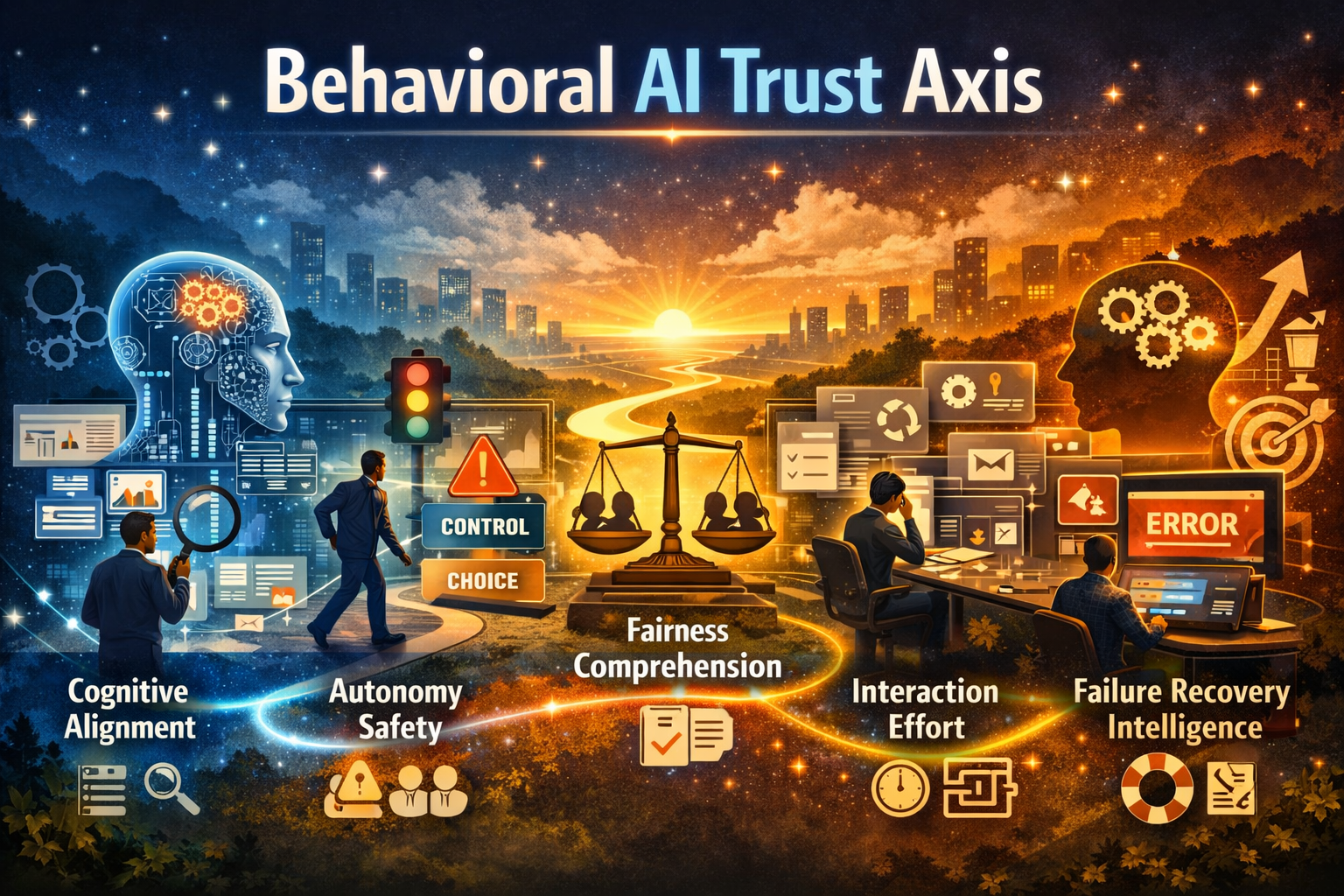
AI adoption succeeds or fails through the AI Trust Axis’ five behavioral dimensions that shape how employees experience technology in practice. These dimensions—Cognitive Alignment, Autonomy Safety, Fairness Comprehension, Interaction Effort, and Failure Recovery Intelligence—explain why technically strong systems can still struggle once deployed at scale.
Cognitive Alignment concerns whether the AI’s reasoning fits the user’s mental model. When outputs feel unintuitive or contradict professional judgment, even accurate recommendations are overridden or ignored. Autonomy Safety reflects whether employees feel their judgment and agency are preserved. If AI appears to constrain discretion or shift responsibility without control, users become cautious or quietly resistant. Fairness Comprehension captures perceptions of consistency and procedural justice; when decision boundaries seem opaque or inconsistent, trust collapses quickly. Interaction Effort measures the friction of using the system—time, cognitive load, workflow disruption—and determines whether employees adopt or revert to familiar tools. Failure Recovery Intelligence describes how well the system helps users detect and correct errors; poor recovery support turns isolated mistakes into lasting aversion.
Together, these dimensions form the behavioral foundation of adoption. When they are supported, people integrate AI naturally and recover from errors without lasting distrust. When strained, adoption becomes fragile, inconsistent, and easily abandoned.
Reinterpreting the Confidence Gap
Viewed through these behavioral dimensions, the Tricentis confidence gap looks less like a governance deficit and more like a set of strained human conditions. Executives trust AI agents because they evaluate them strategically; practitioners distrust them because they experience them behaviorally.
Tool fragmentation increases friction and weakens cognitive alignment by forcing employees to juggle multiple mental models. Opaque decision boundaries undermine fairness comprehension, especially in regulated environments. Unclear escalation pathways threaten autonomy safety, as practitioners fear being accountable for outcomes they cannot fully control. Inconsistent error handling erodes failure recovery intelligence, making a single failure feel like a reason to abandon the system altogether.
These are not technical problems—they are behavioral ones. They explain why organizations see over‑trust in some situations and under‑trust in others, why workarounds and shadow workflows emerge, and why pilots succeed but enterprise rollouts stall. Governance that does not address these dimensions will not close the confidence gap.
Why “More Governance” is Behaviorally Insufficient
Traditional governance frameworks focus on compliance, documentation, and control. They add structure but rarely improve how people experience AI. Oversight mechanisms may satisfy organizational risk requirements, yet they often increase complexity and reduce perceived autonomy. Audit trails and intervention points may make systems more accountable, but they do not make them more understandable, fair, or easy to use.
When governance expands without behavioral design, it can amplify the very pressures that undermine trust. More dashboards do not improve cognitive alignment. More approvals do not strengthen autonomy safety. More documentation does not enhance fairness comprehension. More steps do not reduce interaction effort. And more compliance procedures do not improve failure recovery intelligence.
Governance that adds friction, opacity, or constraint will not make AI more trusted—it will make it more avoided.
Toward Behaviorally-Informed Governance
The path forward is not “more governance” but better governance—governance that is behaviorally informed. Behavioral governance means designing oversight mechanisms that reduce uncertainty, preserve agency, and make reasoning legible. It means embedding fairness cues and recovery pathways directly into workflows rather than treating them as afterthoughts. It means simplifying interaction patterns so AI feels like a natural extension of professional judgment rather than an administrative burden.
Behavioral governance integrates trust architecture, workflow design, and recovery support into a coherent experience. It treats governance as a behavioral intervention, not a structural overlay. When employees can understand how AI reasons, feel confident in their role, perceive fairness, experience low friction, and recover easily from errors, trust becomes durable.
The Tricentis article is right that governance matters—but the AI Trust Axis shows that governance must be designed for human behavior, not just organizational control. Trust will rise not because oversight increases, but because people feel the system makes sense, preserves their judgment, treats cases consistently, reduces effort, and helps them recover when things go wrong. Those are the conditions under which AI becomes not only technically sound but genuinely usable and trusted in everyday practice.