
AI Trust Dispatch
The Human-AI Operating System: Why AI Adoption Is Really About Managing Human-AI Operational Dynamics
16 July 2026
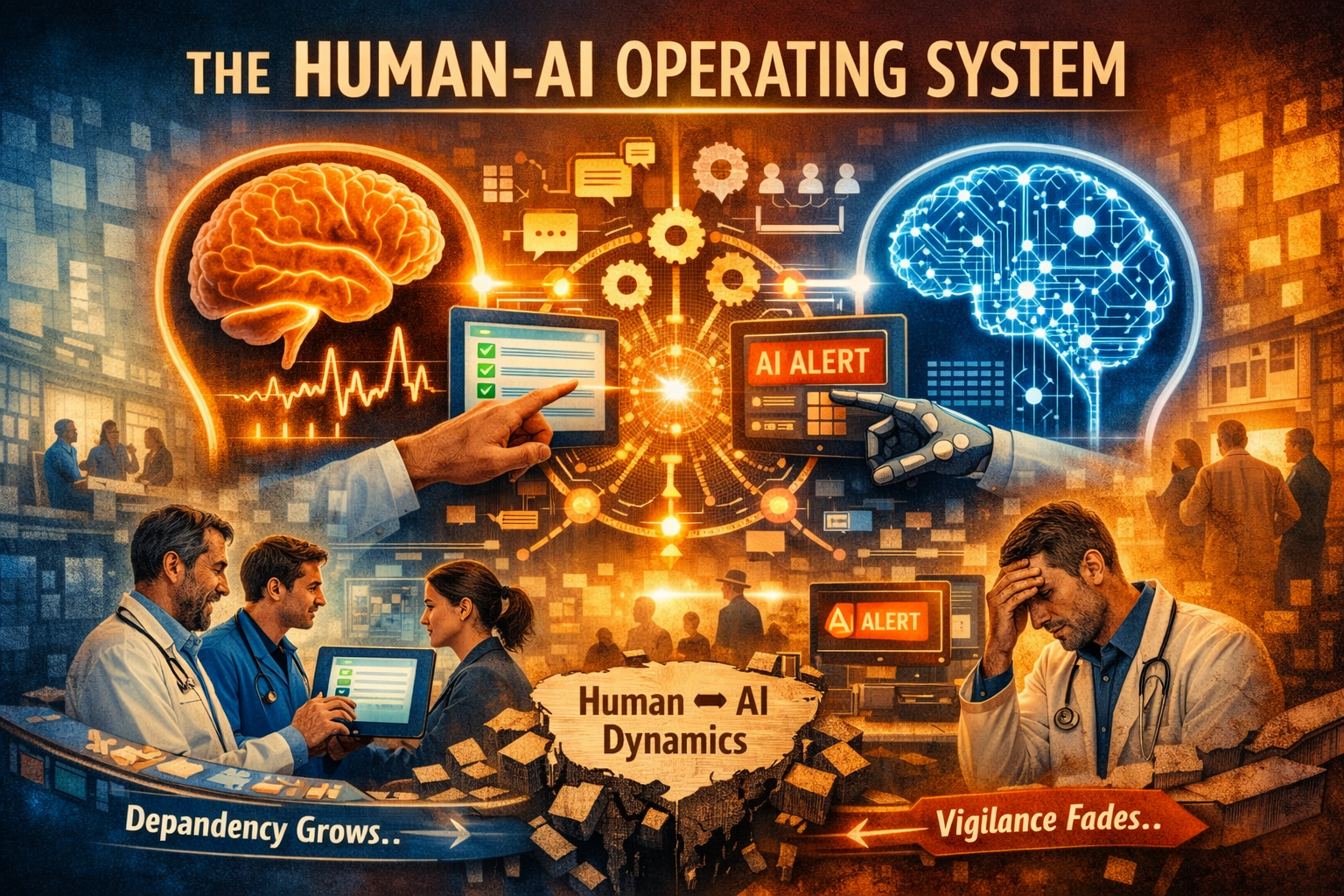
Most organizations think the interface is the screen. In reality, the true interface is the interaction between the AI, the workflow, the institution, and the human nervous system operating under pressure. This is what I refer to as Human-AI Operational Dynamics.
Human-AI Operational Dynamics: The evolving behavioral relationship between professionals, workflows, institutional systems, and AI tools as they continuously adapt to one another under real operational conditions..
Healthcare AI is often treated primarily as an engineering problem. But real-world adoption depends on how humans psychologically adapt to interruptions, delegation, uncertainty, cognitive load, social hierarchy, and changing responsibility structures. AI systems do not enter neutral environments. They enter emotionally intense operational ecosystems.
Why Operational Integration Is Not Enough
As AI becomes integrated into clinical environments, humans and systems begin adapting to one another continuously. Clinicians modify workflows. AI changes attention patterns. Social norms evolve. Delegation boundaries shift. Trust fluctuates. These dynamics create an evolving operational relationship that cannot be understood through technical metrics alone.
This is where process and structure consulting often become insufficient on their own. Process consultants can optimize workflow architecture and operational sequencing, but they cannot fully explain how humans psychologically co-adapt with AI over time. The deeper issue is not simply whether the system fits the workflow mechanically. It is whether the evolving human-AI relationship remains behaviorally sustainable.
What Behavioral Science Reveals
Behavioral science studies how humans and AI systems co-adapt operationally under real conditions. That includes examining trust formation, cognitive strain, social signaling, delegation psychology, behavioral fatigue, and institutional adaptation patterns.
Technical consulting determines whether the AI functions. Behavioral science determines whether the human-AI system functions.
Increasingly, that distinction will define whether healthcare AI becomes sustainably integrated or behaviorally unstable at scale.
How Behavioral Science Resolves the Problem
Behavioral science addresses these implementation failures by treating AI adoption as a human systems problem rather than solely a technical or operational problem. Instead of assuming that clinicians behave as purely rational actors responding predictably to training, governance, or workflow optimization, behavioral analysis examines how trust, cognitive strain, professional identity, social hierarchy, perceived liability, and emotional safety shape real-world decision-making.
In practice, this often involves identifying hidden friction points that traditional consulting approaches overlook. Behavioral consultants study when clinicians feel psychologically safe delegating judgment, how social norms spread across departments, where workflow interactions create cognitive overload, and why professionals disengage from systems despite understanding them intellectually. The interventions themselves are therefore designed to stabilize trust behaviorally rather than simply improve the technology operationally.
This may include recalibrating alert timing, redesigning delegation pathways, reducing identity threat, reinforcing professional autonomy, aligning governance with natural workflow behavior, strengthening peer-led trust formation, or reshaping how the AI is framed psychologically inside the institution. The objective is not merely increasing adoption metrics. It is creating conditions where humans and AI systems can interact sustainably under real clinical pressure.
Case Study
A large hospital network implemented an AI-assisted patient-flow optimization platform intended to improve bed allocation and discharge coordination. Operationally, the deployment appeared highly efficient. Process consultants successfully streamlined workflow sequencing, and leadership praised the system’s ability to reduce delays.
Over time, however, frontline staff began reporting increasing frustration, attentional fatigue, and workflow strain. Nurses described the AI as “constantly pushing the pace,” while physicians felt pressured by algorithmically optimized discharge timing.
The operational system itself functioned correctly. The human-AI operational relationship did not.
Behavioral consultants later identified that the AI had subtly altered cognitive rhythms and interpersonal coordination patterns across units. The intervention focused on redesigning interaction timing, reducing interruption intensity, and restoring greater psychological control over workflow pacing. Once the operational dynamics were recalibrated behaviorally, staff acceptance improved substantially even though the underlying optimization engine remained unchanged.