

AI Trust Dispatch
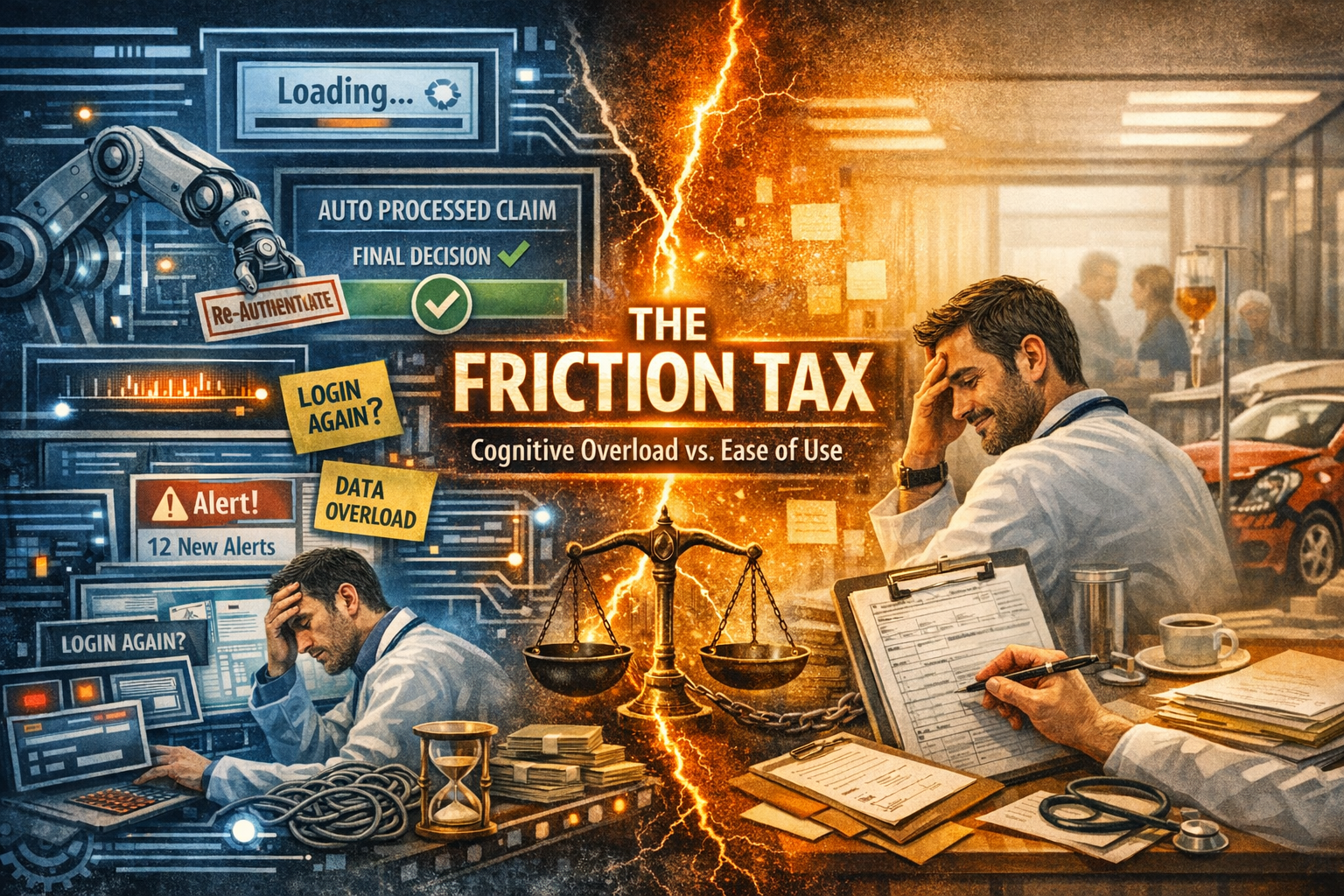
The Friction Tax: Why Clinical AI is Losing to a Paper Chart
16 April 2026
In the executive suite, AI is heralded as a productivity multiplier. But on the hospital floor, it is frequently experienced as a Cognitive Tax.
The urgency of this issue cannot be overstated. We are currently in a "Healthtech Winter" where billions in AI investment are meeting the cold reality of clinician burnout. When we audit for trust, we consistently find that a system’s technical brilliance is undermined by its "Interaction Effort." In behavioral science, this is grounded in Cognitive Load Theory: every extra click, every login hurdle, and every second spent waiting for a model to load isn't just a minor annoyance—it is a signal to the clinician that the system doesn't respect their time.
The Efficiency Illusion and the "Switching Cost"
Healthtech vendors often boast about "streamlining workflows," but they frequently overlook the Switching Cost. Every time a nurse or doctor has to move their eyes from a patient to a screen, or from an EHR to a standalone AI dashboard, they experience a "micro-moment" of cognitive re-orientation.
In a high-acuity environment, these micro-moments accumulate into a massive psychological barrier. Trust is built on predictability and ease. If an AI tool requires more mental energy to navigate than the task it’s supposed to solve, it fails the Friction Test. The user begins to view the AI as an obstacle to patient care rather than an instrument of it.
Three Pain Points Fueling the Adoption Gap
To a COO or CMIO, these might seem like "UX issues," but to a provider, they are Trust Violations:
1. Latency as a Lack of Care
In the ER, a five-second delay for an AI recommendation feels like an eternity. To the human brain, latency doesn't just feel slow; it feels unreliable. If the AI can't keep pace with a clinician's rapid-fire heuristics, it is discarded.
2. The Authentication Barrier
If a clinician has to re-authenticate or jump through multiple security hoops to access an AI insight, the "interaction effort" has already outweighed the potential value. For a provider seeing 20+ patients a day, these hurdles are not just friction—they are reasons to revert to "shadow workflows" or manual intuition.
3. Information Overload (The "Noise" Problem)
Trust is eroded when AI presents 10 data points when only one is actionable. This forces the human to perform the "filtering" work that the machine was supposed to do. This is a transfer of effort from the system to the user, leading to "alert fatigue" and a total collapse of adoption.
The Path Forward: Designing for Zero-Effort Integration
To reclaim the ROI on AI investments, leadership must shift from "Feature-First" to "Workflow-First" thinking. True adoption happens when the AI is invisible—when the insight is delivered at the exact moment of the decision, within the existing visual field of the clinician.
Before approving the next healthtech rollout, ask these three diagnostic questions:
What is the "Click-to-Value" ratio? How many actions are required before the clinician gets a usable, actionable insight?
Does the tool live where the clinician lives? Is it embedded in the EHR, or is it a "destination" they have to visit?
Does it reduce or redistribute the burden? Is the AI actually doing the cognitive heavy lifting, or is it just giving the clinician more data to manage?
In a high-stress clinical environment, ease is the ultimate form of trust. If it’s not easy, it’s not being used—no matter how accurate the model is.