

STORM SHIELD
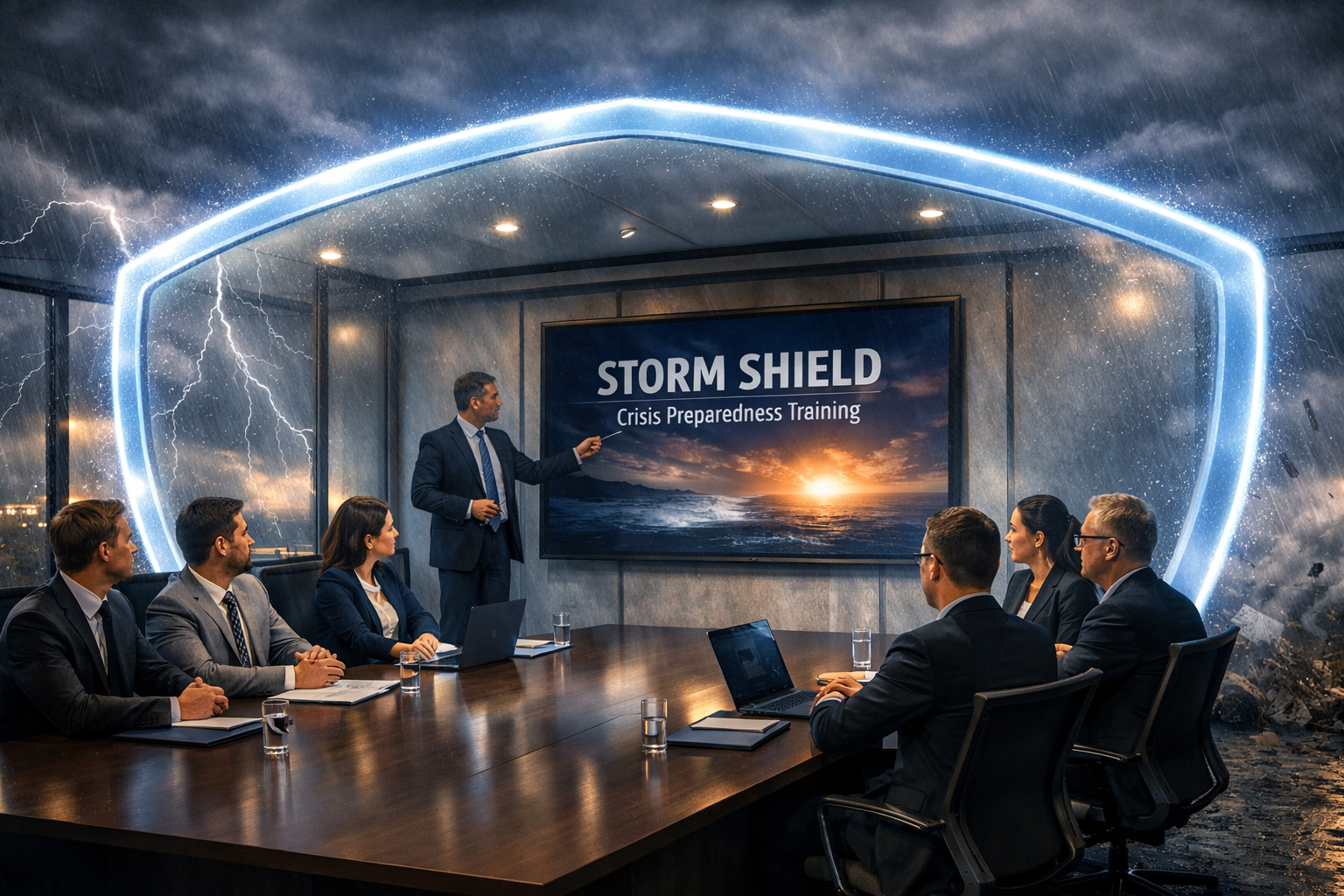
You can’t predict the storm. But you can build the shelter.
STORM SHIELD is a behavioral science-based workshop that prepares brands and PR teams to execute crisis response effectively before a crisis hits, rather than teaching the response playbook itself. Built as a preventive extension of the STORM Framework, it diagnoses the specific organizational conditions—incentive structures that punish early admission of fault, unclear decision rights, untested response reflexes—that cause crisis plans to fail under real stress, and gives participants concrete tools (a readiness audit, decision-rights maps, pre-cleared response templates, and in the full-day version, a live simulation with behavioral debrief) to close those gaps in advance.
Available as a half-day diagnostic-and-planning session or a full-day version that adds a live crisis simulation, it leaves participants with a scored readiness baseline and a personalized action plan, positioning it as the missing "prevention" layer that standard crisis-communications and media training don't cover.
Two formats. You choose.
-
Foundations
HALF-DAY (~3 HOURS)
Diagnostic and planning. Leaves participants with a readiness assessment and concrete artifacts, no live simulation.
From $750 CAD per seat (up to 15).
-
Complete
FULL-DAY (~7 HOURS)
Foundations and a live tabletop crisis simulation and behavioral debrief. This is the version that actually tests whether what they built in the morning survives stress—which is the whole point.
From $1,400 CAD per seat (up to 15).
Half-day modules.
-
Why Crisis Plains Fail Under Stress
Module 1
The behavioral case for the workshop: threat-rigidity response, narrowed cognition under acute stress, and why organizations with a written crisis plan still default to denial and delay. Anchored in the BP/Deepwater Horizon vs. Johnson & Johnson/Tylenol contrast—same available playbook, opposite behavioral execution.
-
The STORM Readiness Audit
Module 2
Participants score their own organization against the five STORM capabilities—not "do we have a policy" but "can we execute this under stress." Delivered as a structured diagnostic instrument, completed individually then discussed in small groups. This is the proprietary scorecard participants keep.
-
Incentive Design: Fixing Why People Don't Own Problems
Module 3
Interactive exercise identifying where their internal incentive structure currently punishes early admission or escalation (career risk, legal reflexes, ego protection). Groups redesign one internal process—an escalation path, a no-blame review structure—that removes the penalty for speaking up early.
-
Pre-Cleared Response Kit
Module 4
Participants draft the artifacts that make Swift Response possible: a decision-rights map (who is authorized to say what, without waiting for sign-off), a spokesperson-readiness checklist, and a first-statement template pre-cleared by legal in principle.
Full-day modules.
-
Live Crisis Simulation
Module 5
A realistic, industry-specific simulated crisis unfolds in real time—social media escalation, incoming media requests, an ambiguous internal signal that was ignored. Participants operate under a countdown, forcing decisions with incomplete information. This is inoculation theory in practice: a weakened, safe exposure to the stressor builds resistance to the panic response when it's real.
-
Behavioral Debrief
Module 6
Not a standard hot-wash. Structured around where the group's behavior diverged from what they designed that morning—where did the incentive to deflect or delay show up even after they'd just redesigned against it. This is usually the most valuable module: it's where people see their own threat-rigidity response happen live.
-
Personalized STORM Readiness Roadmap
Module 7
Each participant or team leaves with a customized action plan referencing their specific audit gaps and simulation performance—not generic recommendations.
Why you should attend.
-
Grounded in the same behavioral mechanisms that explain documented failures (BP) and successes (J&J)—not generic "communicate honestly" advice.
-
Framed as insurance economics: the cost of the workshop is trivial against the cost of a mishandled crisis, and the ROI case is straightforward to make to a CFO.
-
Differentiated from standard media-training: this targets the organizational conditions (incentives, decision rights, escalation) that determine whether good crisis communication is even possible in the moment, not just message drafting.
Prepare for the storm before it arrives.
Every brand will face a crisis. The only question is whether the organization that meets it has spent the calm before the storm building the capacity to respond well, or is left improvising in the moment. The STORM Framework—Swift Response, Transparent Communication, Ownership of the Problem, Re-building Trust, and Monitoring and Learning—gives brands a structured, field-tested approach to navigating a crisis from the first hour through long-term recovery, distinguishing organizations that emerge diminished from those that emerge more trusted than before.
But a framework is only as good as an organization's ability to execute it under pressure, which is why STORM is designed not just as a response protocol, but as the foundation for the kind of preparation—incentive structures, decision rights, rehearsed reflexes—that determines whether a brand can actually deliver on it when the moment comes. The brands that treat crisis management as a discipline, not an afterthought, are the ones that turn their worst days into proof of who they really are.